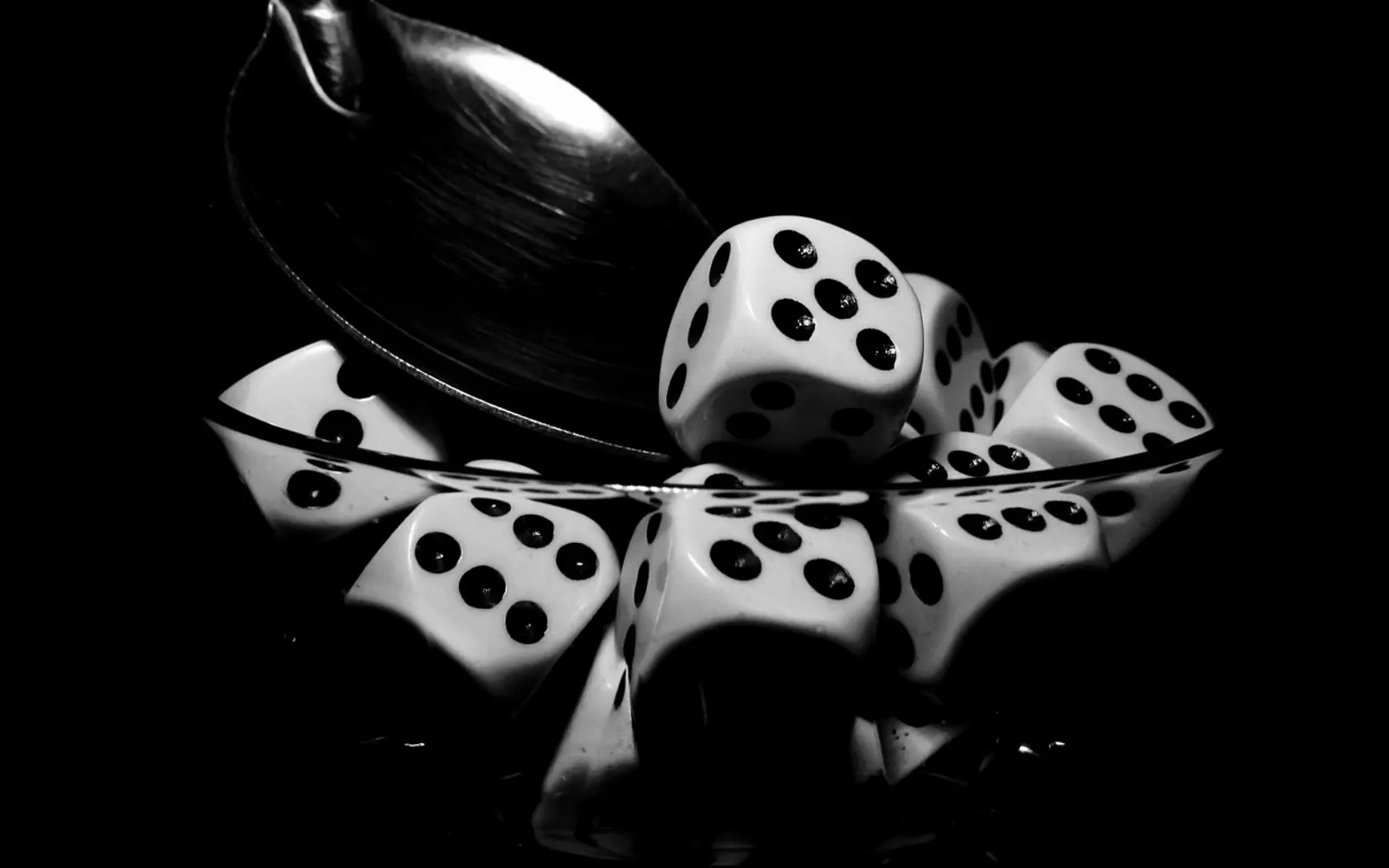
Fish prawn crab, known in Cantonese as hoo hey how, is a dice game played with three dice marked with pictures instead of pips. You place a stake on one of six symbols; for every die that lands showing your symbol, you are paid even money, and if none shows it, the stake is lost. It looks close to a fair bet, but it is not, and the reason makes a neat lesson in casino arithmetic. This explainer is for adults.
The dice and the board
Each die carries the same six pictures. In versions played in Hong Kong, southern China and Singapore these are usually a fish, a prawn, a crab, a rooster, a gourd and a coin. A Vietnamese relative, often called bau cua, swaps some pictures for a tiger or a deer, but works the same way. The betting mat shows the six symbols in a grid, and the dice are shaken under a bowl or inside a small cage before being revealed.
The game is closely related to two Western dice games: Crown and Anchor, which uses card suits plus a crown and an anchor, and Chuck-a-luck, which uses numbered dice in a spinning cage. All three share the same payout structure.
How a round works
- Players put stakes on one or more symbols on the mat.
- The banker shakes the three dice under cover.
- The cover is lifted and the dice are read.
- Each stake is paid 1 to 1 for each die showing its symbol: one match pays even money, two matches pay 2 to 1, three matches pay 3 to 1.
- Stakes on symbols that did not appear are collected by the banker.
Some mats add combination bets that pay when two chosen symbols both appear, or bets on a specific triple. Payouts for those vary, so compare each one with its odds before playing.
The chance of a match is lower than it looks
There are three dice and six symbols, so it is tempting to think your symbol turns up half the time. It does not. Three dice can land in 6 × 6 × 6 = 216 equally likely ways, and the chance of your symbol appearing on a given number of dice works out like this:
| Dice showing your symbol | Ways out of 216 | Chance | Result for a 1-unit stake |
|---|---|---|---|
| None | 125 | About 57.9% | Lose 1 |
| One | 75 | About 34.7% | Win 1 |
| Two | 15 | About 6.9% | Win 2 |
| Three | 1 | About 0.5% | Win 3 |
Your symbol appears at least once in only 91 of the 216 outcomes, about 42%. The reason is overlap: rolls where the symbol lands on two or three dice use up chances that would otherwise spread across separate rolls.
Working out the house edge
Using the table, imagine 216 rounds, each with every possible outcome happening once, at a stake of 1 unit:
- Winnings: 75 rounds × 1 + 15 rounds × 2 + 1 round × 3 = 108 units.
- Losses: 125 rounds × 1 = 125 units.
- Net: a loss of 17 units over 216 rounds staked.
Seventeen out of 216 is about 7.9%. That is the house edge on a single-symbol bet with this payout, and it is the same figure as the single-number bet in sic bo, which uses the identical structure with numbered dice. Our guide on how to play sic bo sets that game's other bets beside it, several of which are cheaper.
Betting on several symbols at once does not reduce the edge. Each stake carries its own 7.9% price, and covering more symbols simply means more money exposed to it.
A family custom and a casino game
Fish prawn crab is widely played as a household pastime around the Lunar New Year, often for very small stakes, with whoever has the dice acting as banker. In that setting, the 7.9% margin is a quiet transfer to the banker across the evening. Casino and online versions keep the same structure, sometimes with extra combination bets and animated reveals, and the same arithmetic applies. As with any game of dice, recent results tell you nothing about the next shake.
Questions readers ask
Is there a strategy for fish prawn crab?
No choice changes the odds of a single-symbol bet. The only real decisions are how much to stake and when to stop.
Why do some tables pay more for triples?
Some versions pay a bonus when all three dice show your symbol. That lowers the edge slightly, which is a good reason to read the payout card first.
How does it compare with other Asian table games?
It is among the simplest and one of the more expensive per bet. Card-based games such as pai gow tiles move more slowly and push often, while Big and Small in sic bo carry a much smaller margin.
Even when played for small change, stakes add up across a long evening. Keep the amount modest and fixed, play only as an adult, and remember that rules on dice games for money vary between countries.